
Monument Response Project
Chicago, IL — March 26, 2026 — The Chicago Park District launched the Monument Response Project as part of the Chicago Monuments Project, inviting artists to create site-responsive installations and performances at selected monuments across the city. The initiative seeks to reimagine public narratives that reflect Chicago’s diverse histories and cultures. By fostering community engagement and creative dialogue, the project advances equitable public art that critically examines contested legacies and encourages more inclusive forms of commemoration within the city’s parks.
Over the two-year exhibition, these projects will present multiple public programs, performances, and educational events engaging thousands of Chicago residents and visitors. Through partnerships with cultural institutions and community organizations, the installations will expand dialogue around monuments, historical memory, and cultural representation while modeling new approaches to public art in civic space.
We Still Here: A Site-Responsive Temporal Public Art Installation
by Sonja Henderson and Sadie Woods
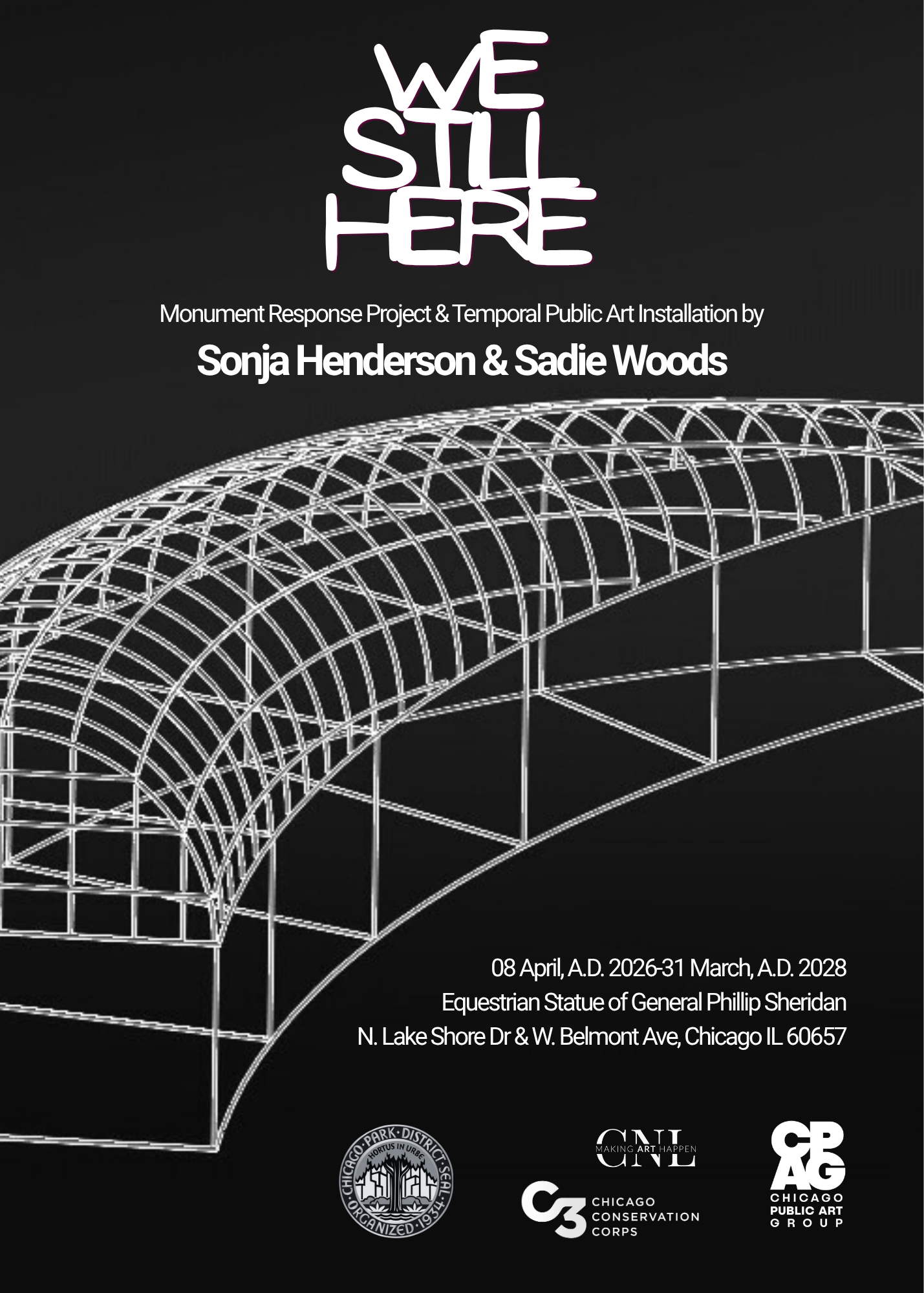
We Still Here is a site-specific temporal public art installation presented through the Monument Response Project. The work honors the enduring histories and living cultures of Indigenous peoples through an ecological lens centered on Turtle Island—also known as America—with particular focus on the American bison and its essential role in the ecosystems of the Great Plains, often referred to as bison country.
Collaboratively created by artists Sonja Henderson and Sadie Woods, We Still Here serves as a powerful declaration of presence, memory, and self-determination. Installed at the equestrian statue of General Philip Sheridan at Lake Shore Drive and Belmont Avenue, the project recontextualizes one of Chicago’s most prominent monuments. Sheridan’s widely cited statement, “The only good Indians I ever saw were dead,” reflects ideologies of his time, including scorched-earth military campaigns and the deliberate decimation of bison populations as a means of subjugating Indigenous nations. By placing this installation at the base of his statue, We Still Here invites viewers to critically engage with dominant narratives of power, heroism, and public memory.
The installation features two 16-foot-long, 4-foot-high sacred bison horns constructed from steel rod, arching around the south-facing plinth of the statue. Within the horns are high-fire porcelain and stoneware cast bison skulls and bone curtain, representations of Prairie flora and fauna, and cenotaph objects honoring wildlife. Alcoves throughout the installation display curated historic imagery from archives of Prairieland ecosystems and temporal soundscape, creating a multisensory and dialogic experience rooted in storytelling, placemaking, and civic engagement—a central metaphor for prairieland preservation and survival.
We Still Here recognizes histories essential to Chicago neighborhoods like Lakeview, shaped by communities rooted in diverse tribes and nations, and cultural heritage as the point of departure for the installation. It affirms that these collective histories are not relics of the past but are living within the present and future. By engaging the equestrian statue of General Sheridan—a symbol of victor’s history set in bison country and linked to both the Civil War and the Indian Wars—the installation also reflects Sheridan's role in the Great Chicago Fire of 1871, where military strategies were employed in westward expansion. We Still Here makes visible what has been rendered invisible and opens space for reflection on how public monuments shape collective memory, particularly when erected on repurposed tribal lands.
TIERRA NUESTRA: A Site-Specific Public Art Installation
by Hector Gonzalez
UPCOMING PROGRAMMING
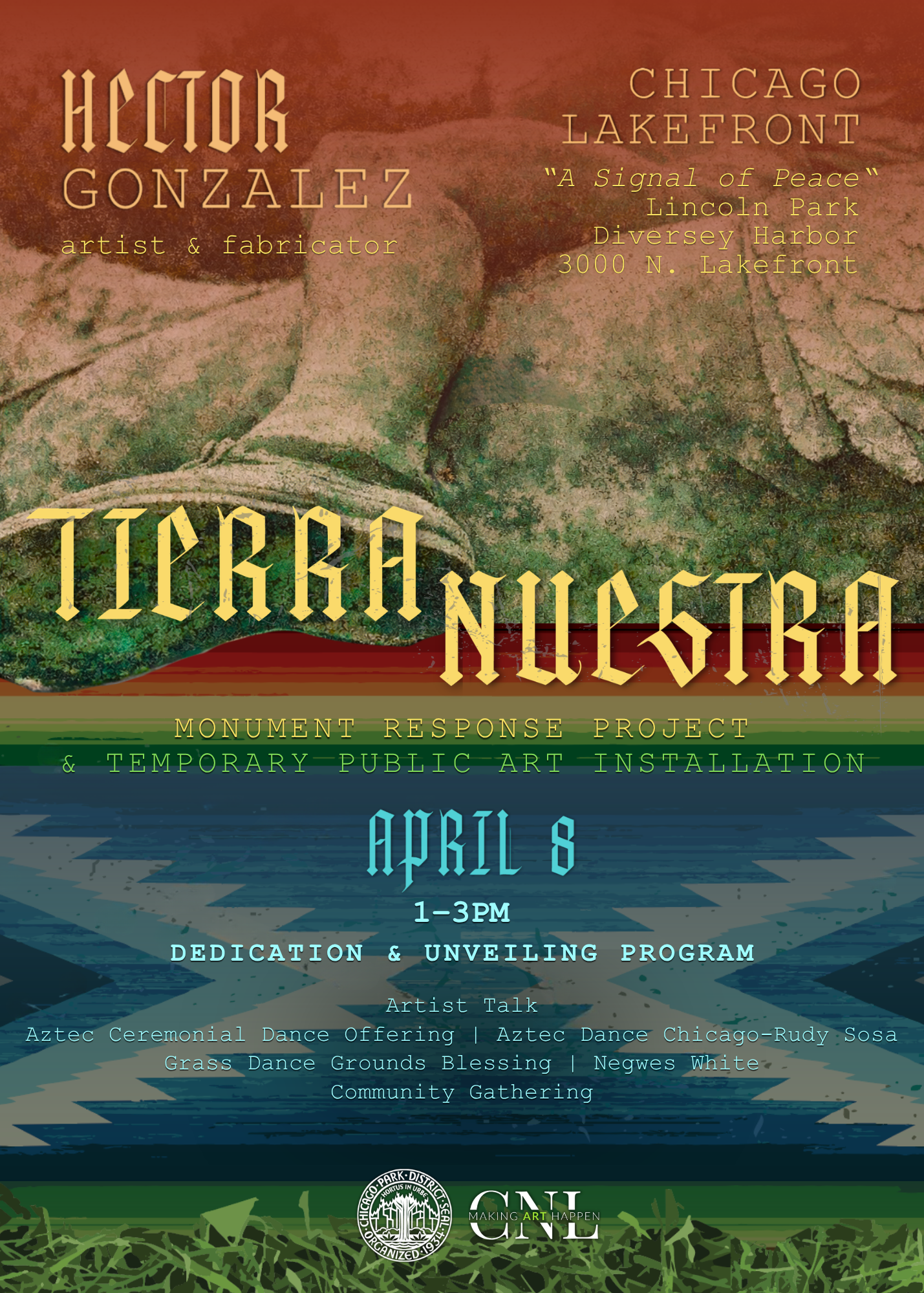
You are cordially invited to the opening reception of TIERRA NUESTRA on Wednesday, April 8, 2026, from 1 PM to 3 PM, at East of N. Lake Shore Drive north of Diversey Harbor, Chicago, IL 60614. Join us for an artist talk, an Aztec Ceremonial Dance Offering by Aztec Dance Chicago and Rudy Sosa, a Grass Dance Grounds Blessing by Negwes White, and a community gathering.
TIERRA NUESTRA is a temporary public art installation by Chicago artist Hector Gonzalez created in dialogue with A Signal of Peace (1890). The work introduces a contemporary rider of Native Mexican and mixed Native American heritage standing atop a single horse, forming a powerful response to questions of history, belonging, visibility, and cultural memory.
As the second-largest racial group in Chicago, Mexican Americans have long contributed to the city’s culture, labor, and life. Yet the story, especially the part that connects Native Mexican American people to Native America through history and geography, has been overlooked or ignored. Before borders split the land, Native peoples—including those from regions that became the USA—moved freely. Many Mexican Americans are descended from those people, yet we are not taught that history connects Native Mexicans and Native Americans within North America. Leaving some Mexicans to feel they do not belong neither here nor there. This piece reclaims that missing narrative and invites viewers to consider, “What if we have always known who we were?”
Finished in a rich patina that harmonizes with the historic monument, the installation also includes two wooden benches positioned in front of the sculpture, each crafted from a single slab of wood. The tops of the benches feature Native American and Native Mexican-inspired serape designs with the words “Seguimos Aquí” woven into the patterned textile surface, creating a welcoming space for gathering, reflection, and shared presence.
Finished in a rich patina that harmonizes with the historic monument, the installation also includes two wooden benches positioned in front of the sculpture, each crafted from a single slab of wood upcycled from locally sourced trees. The tops of the benches feature Native American and Native Mexican-inspired serape designs with the words “Seguimos Aquí” woven into the patterned textile surface, creating a welcoming space for gathering, reflection, and shared presence.
TIERRA NUESTRA creates a space for dialogue—between past and future, city and nature, visibility and invisibility. It stands as an offering to Chicago and to this country that supports the freedom to question, reflect, and seek peace within oneself and our shared history. It invites the people of Chicago— and beyond—to reconsider what American history might look like when all of its voices are truly heard. “This work is a symbol of peace: a peace discovered through learning my own story, and one I now hope to offer to others.”
–Hector Gonzalez
UPCOMING PROGRAMMING
You are cordially invited to the opening reception of We Still Here on Wednesday, April 8, 2026 at General Philip Sheridan Equestrian Statue on Lake Shore Drive & Belmont Avenue, Chicago, IL 60657, from 5:30-8:00 PM. Join us for ephemeral sonic art installation by Sadie Woods, ceremonial procession led by Zahra Baker, 4 directions salutation and land consecration by Alfonso “Piloto” Nieves-Ruiz and sacred herb smudging by Sonja Henderson, performance by Chicago Poet Laureate Mayda del Valle, breathwork ritual by Toni Asante Lightfoot, and prairie plant landscaping by Peggy Notebaert Nature Museum Chicago Conservation Corps led by Zibby Foos. Exhibition runs through March 31, 2028.
Rewilding: C3 Initiative | Plant Conservation & Community Gardening with Conservationist Zibby Foos | Saturdays • 10:00 AM-01:00 PM | 06 June, 11 July, 01 August, 05 September, 03 October, A.D. 2026
HA Harmonic | Graphic Score Performance | Sadie Woods ft. Angel Bat Dawid, Ben LaMar Gay, Corey Wilkes | Saturday, 19 September, A.D. 2026 | 3:00-4:00 PM
MRP Public Art & Monuments Panel | Sadie Woods, Music as a Living Monument: Sound, Memory, and Civic Space | Saturday, 19 September, A.D. 2026 | 12:00 - 01:00 PM | Pre-recorded Program Released via Online Streaming Platform
ABOUT
With more than 8,800 acres of green space, the Chicago Park District is one of the largest municipal park managers in the nation. The District’s more than 600 parks offer thousands of sports and physical activities as well as cultural and environmental programs for youth, adults, and seniors. The Chicago Park District is also responsible for 27 indoor pools, 50 outdoor pools, and 26 miles of lakefront. From canoeing to soccer to arts and crafts, there is never a shortage of activities in Chicago’s parks.
CNL Projects (CNL) is an art consulting firm that provides art advising to clients with a specialization in public art, private art collections, and creative program design. CNL was founded in 2014 by Cortney Lederer to provide artists and organizations with a platform to creatively produce impactful art experiences.